

Washington Crossing The Delaware

PENDING RESTORATION
THE LOST PAVILION MURAL
The artist, the late John DeCuir Sr., was a three‑time Academy Award–winning production designer whose work shaped some of Hollywood’s most iconic visual worlds. He recreated the original artwork for Disney’s Hall of Presidents, leading a team that produced more than 85 historically significant paintings — some mural‑sized — for the attraction’s filmed sequences. Today, his Burden of War hangs in the Disneyland Opera House beside Herb Ryman’s Presidential Campaign, greeting guests before Great Moments with Mr. Lincoln.
Measuring roughly 5 by 14 feet, this recreation of Emanuel Leutze’s Washington Crossing the Delaware captures the drama and symbolism of the Christmas crossing that renewed the cause of liberty at a moment of profound uncertainty. It is faithful to the original yet unmistakably cinematic — composed by a production designer who understood how images must move, breathe, and invite an audience inside.
When asked what I do, I often say — half seriously — that I “copy things”: the Roman Forum, Cleopatra’s Alexandria, the Sistine Chapel, the Titanic underwater, the Statue of Liberty. Copying, in our cinematic world, is not duplication but world‑building. It is how we reconstruct environments for storytelling. This painting belongs to that lineage.

Newly uncovered sketches and notes reveal that the mural was never meant to hang passively on a wall. It was conceived as the opening image for what we now, perhaps a touch presumptuously but fittingly, call American Adventure II — a pavilion where drawings didn’t just depict history, they activated it. Paired with the Space Pavilion concept John developed with Ray Bradbury — and my own work on the 3D Muppet Movie — this project marked Imagineering’s late‑1970s leap in animation technology, dimensional sets, and audience motion, bringing stories fully to life. So indeed it is a piece of Imagineering history.
Walt began this lineage. His creativity started with drawing farm animals and eventually a little mouse that came to life. He believed imagination begins with a pencil. Animation made drawings move; dimensional figures made them breathe. Lincoln came to life. The Presidents spoke. History became presence. DeCuir Sr.’s pavilion design was a “next step” in that “coming to life” we call transvergence where suspension of disbelief lives.
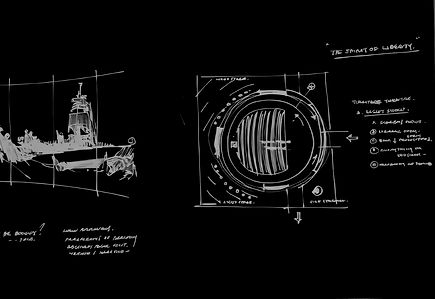
The rotating turntable wasn’t a gimmick — it was a storytelling engine. Like the Carousel of Progress, audience motion became part of the coming‑to‑life narrative. By rotating viewers through sequential environments, the pavilion broke the boundary between traditional theatre and the Disney dark ride. Instead of watching scenes unfold, the audience entered them. Each rotation delivered a new animated sequence, a new dimensional tableau, a new moment where drawings became environments and history became experience.
The mural was the conceptual opening‑scene anchor — a widescreen narrative frame designed to expand outward into sets, projection, lighting, and motion. It was the first step toward a future where American history wasn’t just told, but staged around you, moving with you, coming alive because you were inside it.
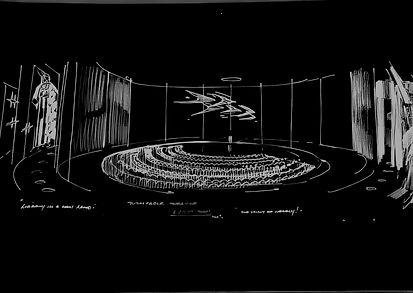
To understand the creative spark behind this pavilion, here are several notebook bursts (paraphrased slightly due to image quality) from DeCuir Sr.’s working notes — spontaneous, fragmentary flashes of imagination:
“Crossing isn’t a scene — it’s motion. Ice cracking, men shifting weight. Walt made Lincoln breathe… why can’t the whole Revolution breathe? Not a painting… a moment waking up.”
“Turntable = heartbeat. Audience moves → story moves. Rotate them through the picture. Make them feel the painting turning alive around them.”
“Sketch first. Pencil first, world later. Build the drawing. Let them walk inside the drawing. Let the drawing take over.”
These bursts reveal the core educational motivator behind the pavilion — and behind our restoration effort today: the idea that drawings can come to life. This concept is not merely theatrical; it is pedagogical. When a drawing “comes to life,” it transforms passive viewing into active understanding. It turns history from something observed into something experienced. Students remember what they enter. They retain what they feel. They learn from what they can walk inside.
This is the heart of our mission: to use cinematic design to teach how imagination becomes matter — how drawings become worlds. How EPCOT may in fact become a city of tomorrow.

This history is one reason we are building the John DeCuir Production Design Study Center at Asbury University, where more than 6,000 drawings, renderings, scripts, and artifacts now document Hollywood’s Golden Age of narrative copying — an era that seeded both classic cinema and the birth of Disneyland.
Which brings us to the question: what should become of this painting?
Our intention is to restore it to its original visual potency and use it as the spearhead for a curated exhibition introducing audiences to the history of narrative cinematic art — coming to life. This traveling show would highlight the host gallery’s programming while building sponsorship and grant support for the Study Center’s educational mission. Supporting George’s Crossing would be other DeCuir works including Cleopatra’s Black Pyramid, The Titanic Under Water, Michelangelo’s Sistine Chapel, and Hitchcock’s Statue of Liberty.
As the nation celebrates the second half of its 250th‑anniversary observance, we believe this painting — “George Crossing,” as we’ve come to call it — offers a timely opportunity to illuminate both the American Adventure and the broader cultural legacy of cinematic design.
With appreciation,
John DeCuir
John DeCuir Production Design Study Center
Asbury University